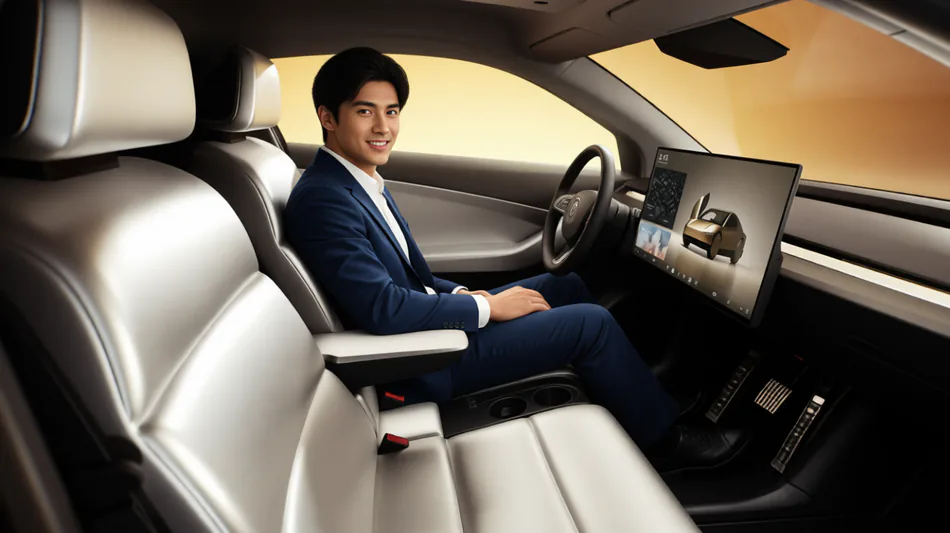
Elon Musk Promises Steering-Wheel-Free Tesla Model Y Amid Cybercab Sales Launch

Tesla CEO Elon Musk revealed during the New York Times’ DealBook Summit that the company intends to produce a version of its popular Model Y crossover devoid of steering wheels and pedals. This announcement coincides with Tesla’s launch of limited sales for its two-seater Cybercab, which requires subscribers to pay a recurring monthly fee to access its autonomous driving features.
Elon Musk stated in mid-November that Tesla plans to eventually manufacture a variant of its best-selling Model Y crossover that lacks any driver controls, including a steering wheel or pedals. The comment was made during a broader interview at the New York Times’ DealBook Summit earlier this week, where Musk outlined future product directions for the electric vehicle manufacturer.
Musk described the concept as an "autonomous version of the Model Y that won’t have steering wheels or pedals." He framed the potential vehicle as a necessary evolution to address capacity limitations in Tesla’s current autonomous offerings. Specifically, he noted that the company’s newly unveiled Cybercab, which is currently transporting passengers in select cities across Texas and Florida, is designed to carry only two people.
"We still need autonomous vehicles if you’ve got four or six [passengers], or a whole family," Musk said during the summit appearance. The remark suggests that Tesla aims to expand its autonomous fleet beyond two-seater configurations to accommodate larger groups and families, provided the technology can be scaled effectively without traditional driver interfaces.
It remains unclear whether the steering-wheel-less Model Y represents a finalized product roadmap or a speculative comment characteristic of Musk’s public communications. Significant operational details have not been disclosed, including the manufacturing location for such a vehicle, its projected price point, and a timeline for market release. Bringing a vehicle without standard driver controls to production would require substantial modifications to Tesla’s existing assembly processes, moving beyond simple removal of components from conventional Model Y units.
In parallel with these future announcements, Tesla has begun offering its Cybercab to "select customers." The two-seater autonomous taxi is available at a base price of $29,990. However, the cost of ownership includes an additional recurring monthly fee of $299 for the vehicle’s autonomous driving capabilities.
This subscription model, referred to as the "Autonomy Subscription," has drawn attention for its structure and restrictions. According to reports from Automotive News, the subscription fee is subject to change with only 30 days’ notice. Furthermore, the autonomous functionality is restricted to specific geo-fenced zones within the United States.
The launch of the Cybercab raises questions about its role in Tesla’s broader robotaxi ambitions. While Tesla has previously discussed allowing private owners to integrate their vehicles into a commercial robotaxi fleet to generate passive income, such commercial use appears to be prohibited during this initial rollout phase. It is also not yet clear when or if the Cybercab will become available for purchase by the general public in large numbers.
Tesla’s history with autonomous vehicle timelines has been marked by significant delays. The company originally promised the deployment of one million robotaxis by 2020, a target that was never met. The current launch of the Cybercab to select customers marks a step toward that goal, but the reliance on monthly subscriptions for core functionality and the limited geographic scope of its autonomous operation highlight the ongoing challenges in achieving widespread commercial autonomy.
The introduction of the Cybercab and the promise of a driverless Model Y underscore Tesla’s continued focus on full self-driving technology. However, the gap between Musk’s announcements and tangible product availability remains wide, with many details regarding production, pricing, and regulatory approval still unresolved.
V.al-Arrayed--BT