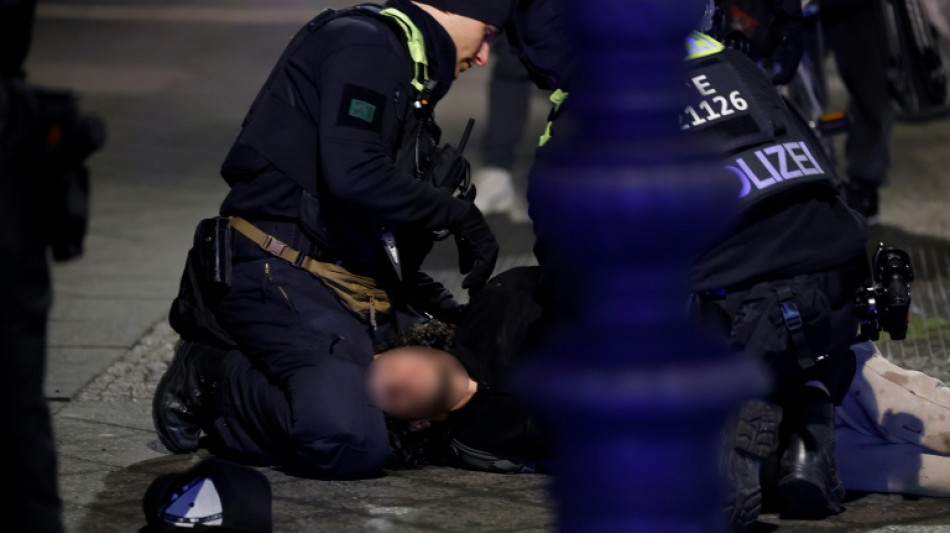
Syrian jailed over stabbing at Berlin Holocaust memorial / Photo: © AFP

A Berlin court on Thursday jailed a Syrian man for 13 years for a jihadist-inspired knife attack on a Spanish tourist at the German capital's Holocaust memorial.
The 20-year-old suspect, named only as Wassim Al M., was convicted of attempted murder, grievous bodily harm and attempted membership of a terrorist organisation, the court said.
The stabbing in February 2025 inflamed an already heated debate on migration just a few days before a general election in Germany.
Presiding judge Doris Husch said said Al M. had committed the crime "in the name of the Islamic State (IS) group".
"The victim only survived because the defendant missed major blood vessels by a few millimetres," she said.
In a statement before the trial, the court said Al M. had intended to "target a person of the Jewish faith".
He approached the 30-year-old victim from behind, among the concrete steles of the memorial, and "inflicted a 14-centimetre-long (more than five-inch) cut to his throat with a knife", the court said.
The victim, who was visiting the memorial with two friends, was badly wounded but managed to stagger out of the steles before collapsing in front of the memorial.
As Al M. was 19 at the time of the attack, the judges had to decide whether to apply juvenile or adult law under a special system for offenders aged 18-20 in Germany.
They ruled he should be treated as an adult based on his emotional and psychological maturity at the time.
- 'Deep shame' -
During the trial, Al M. confessed to the crime, which he said had been motivated by his radicalisation and belief he was acting with a religious mission.
"My shame is too deep, I ask for forgiveness," he told the court, according to his lawyer.
Prosecutors said Al M. had "internalised IS ideology, rejected the Western way of life, and was convinced that a holy war against infidels must be waged worldwide".
He shouted "Allahu akbar", or "God is the greatest", after the attack, the court was told.
The suspect had travelled to Berlin from his home in the eastern city of Leipzig, motivated by his support for IS and "driven by the escalation of the Middle East conflict".
Prosecutors said that shortly before the attack, he had sent a photo of himself to members of IS via a messaging service and offered his services as an IS member.
Al M. "wanted to kill", prosecutor Michael Neuhaus told AFP on the sidelines of the trial.
- Migration debate -
"He had become radicalised in line with IS ideology..., believed he had a religious mission, wanted to send a message against liberal society and against Jews," Neuhaus said.
Al M. was arrested when he returned to the scene of the attack with blood stains on his hands, carrying a copy of the Koran and a prayer rug.
The assault shocked Germany two days before the February 2025 general election, after a campaign centred heavily on immigration and security fuelled by a series of deadly stabbing and car ramming attacks carried out by migrants.
Germany is home to around a million Syrians -- many of whom arrived during the huge influx of refugees that peaked in 2015 under former chancellor Angela Merkel.
Since the overthrow of president Bashar al-Assad, debate has grown heated around whether wartime refugees should return to Syria.
The far-right Alternative for Germany (AfD) in particular has called for them to go home, highlighting a recent spate of high-profile violent crimes.
Germany's conservative-led government in December deported a convicted criminal to Syria for the first time since 2011, following months of talks with Syria's new government.
T.al-Shamlan--BT