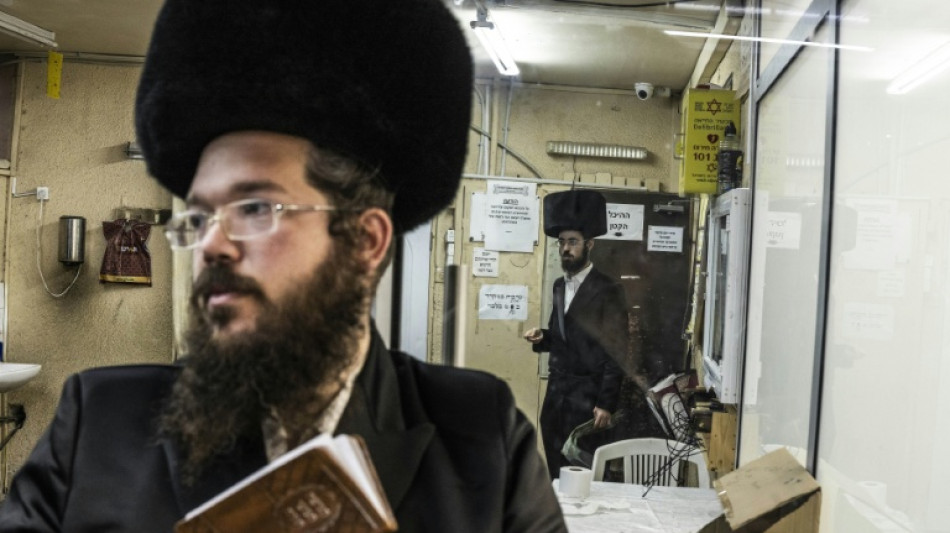
Ahead of Israel vote, desert town becomes frontline against ultra-Orthodox expansion / Photo: © AFP
Noam Cohen was driving to a bar on a Saturday two years ago with his wife and friends in his hometown of Arad, in southern Israel, when a group of ultra-Orthodox Jewish boys began shouting at passing cars.
The drivers were guilty of violating the Sabbath, the Jewish day of rest. The boys also insulted the women in the group, including Cohen's wife.
"That's where I started to lose my temper," Cohen told AFP. "It touched me personally."
The incident pushed Cohen to join a growing protest movement of secular residents, who say the expanding ultra-Orthodox population is reshaping the character of their hometown.
"It's no longer the same city I grew up in," resident Einat Jupiter said.
As Israelis prepare to vote in parliamentary elections on October 27, tensions in Arad, where people took to the streets to demonstrate several times this year, have become a microcosm of a broader national debate.
An especially sore point is how Israel exempts religious students from military service, at a time that forces are stretched following three years of war.
"What's happening in Arad can reflect the future of the entire State of Israel," Cohen said.
The ultra-Orthodox "simply have more children", he said. "You can't fight against that."
Ultra-Orthodox Jews account for more than 14 percent of Israel's population. Their share is projected to reach roughly one-quarter by mid-century.
Their growing demographic weight, driven by a fertility rate of 6.5 children per woman, has translated into political influence.
Two ultra-Orthodox parties support Prime Minister Benjamin Netanyahu's governing coalition and have long wielded significant leverage over issues ranging from the military service exemption to budget allocations.
For many secular residents of Arad, that tension feels increasingly personal.
"We can't live together. Our lives and theirs are completely different; we're not compatible," Cohen said.
- 'Politics is only about security' -
Nestled on the edge of the Negev desert overlooking the Dead Sea, Arad, which has a population of 30,000, was once known as a prosperous and secular community.
During the 1980s, it ranked among Israel's more affluent municipalities and hosted the country's largest music festival.
But economic decline prompted many secular residents to leave from the late 1980s onwards.
Soviet Jewish immigrants arrived in large numbers during the 1990s, while affordable housing later attracted growing numbers of ultra-Orthodox families.
Today, the ultra-Orthodox account for around 40 percent of the city's residents, according to Nisan Ben Hamo, who served as mayor from 2015 to 2024.
Successive governments neglected Israel's geographic periphery, focusing overwhelmingly on security issues, he said.
"When politics is only about security, every other issue gets left behind," he told AFP.
His secular faction lost control of the municipality after 2024 local elections, when ultra-Orthodox residents turned out to vote in large numbers.
"They are better organised than us," Ben Hamo said.
He sees a lesson for secular Israelis ahead of the national election.
"The liberals need to wake up to increase their voting rates if we want to win, because the other side, the extreme right wing, and the ultra-Orthodox are better organised. They control the people, and they (mobilise) them in high percentages."
- Public space battleground -
For residents such as Shlomi Tabchik, the dispute centres on public space as much as politics.
The municipality, he alleged, was increasingly allocating public buildings and resources to the ultra-Orthodox community.
He complained that some rocket shelters had been turned into prayer rooms, reducing their availability during emergencies.
"When missiles fall on us, we need shelters, but we cannot use them because the shelter has become a synagogue. It's outrageous. Who is (the municipality) really looking after?" Tabchik said.
In March, 84 Arad residents were wounded when an Iranian missile fell in the city, according to rescue services.
Tabchik lamented that investment in entertainment and community activities had also declined, weakening the social fabric of a town that once felt like a village.
Residents complained of vandalism targeting images of women in advertisements, reflecting a religious opposition to displaying women's photographs in public spaces.
"They want the city for themselves and they want us out," Tabchik said.
- 'I want to live freely' -
Ultra-Orthodox residents reject the notion that they are taking over the city.
Yitzhak Gordon, a prominent member of the community and director of Arad's finance department, said he saw relations as mostly friendly.
Complaints about the Haredi community were amplified by people "who sit all day on the internet" including Facebook, he told AFP.
"The young, secular population is leaving Arad. And the school classrooms are emptying," Gordon said. "We also need places to study."
Even some secular residents acknowledge that day-to-day coexistence is generally peaceful.
"We are all human beings," Jupiter said. "People learn to get along."
Yet she worries that ultra-Orthodox residents want the rest of the city to conform to their lifestyle.
"It won't work, because I'm a free person. I want to live freely," she said.
J.al-Haddad--BT