Naresh Kumar Kumawat Unveils 'The Mirror Within' at India Biennale 2026
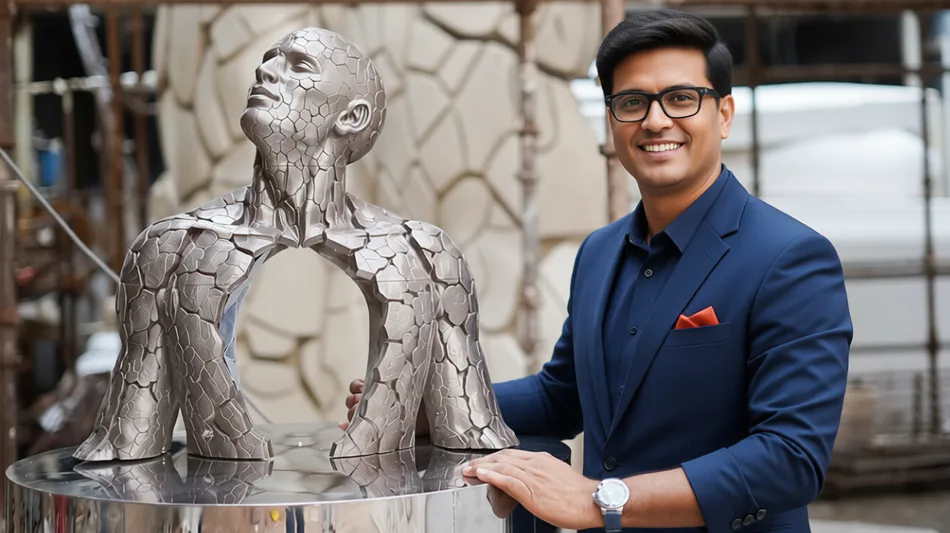
Sculptor Naresh Kumar Kumawat will showcase his 22-foot stainless steel installation, 'The Mirror Within,' at the India Art, Architecture & Design Biennale 2026 in Delhi starting December 4. Inspired by the Upanishadic concept of interconnectedness, the work invites viewers to see themselves reflected within the sculpture, marking a philosophical departure from his previous monumental religious and political statues.
Sculptor Naresh Kumar Kumawat is set to present 'The Mirror Within,' a 22-foot stainless steel installation, at the India Art, Architecture & Design Biennale 2026 in Delhi. The work, which opens on December 4, utilizes a mirror finish to reflect viewers back into the sculpture, embodying the Upanishadic philosophy of 'Tat Tvam Asi,' or 'You Are That.'
The installation marks a significant shift in Kumawat’s career, which has been defined by large-scale depictions of deities and public figures. His previous works include the 369-foot Statue of Belief (Shiva) in Nathdwara, Rajasthan; the 206-foot Statue of Social Justice featuring Sardar Vallabhbhai Patel and Dr. B.R. Ambedkar at the New Parliament Building; and a 51-foot statue of Lord Ram installed in Canada last year.
'The Mirror Within' departs from these traditional forms by focusing on introspection rather than external representation. Kumawat designed the piece to explore the idea that an individual is not separate from the world around them. The sculpture features an upward-facing head, symbolizing awareness and the search for truth, and an open chest cavity representing the inner self. The polished stainless steel surface allows visitors to see themselves as part of the artwork, merging the viewer with the piece.
In an interview with the Free Press Journal, Kumawat explained that the philosophy is particularly relevant in a contemporary context where individuals are often influenced by external opinions and social pressures. 'Our identity is connected to something much larger than ourselves,' he said. However, he emphasized that the work does not prescribe a single interpretation. 'I would leave it to each visitor to look at the sculpture and find their own meaning in it.'
The mirror finish captures more than just the viewer; it also reflects the sky, the surrounding landscape, and the movement of people around the installation. Kumawat noted that these reflections change constantly, ensuring that no two viewing experiences are identical. Achieving this effect required precise attention to detail, as even minor imperfections in the finish could significantly alter the sculpture's appearance.
The creation of the installation involved close collaboration between artists, craftsmen, and engineers to ensure both proportion and structural strength. While Kumawat welcomes the use of digital modeling and 3D scanning to assist with measurements for large-scale works, he maintains that technology cannot replace the understanding an artist develops through hands-on experience. 'Technology may simplify certain steps, but it cannot eliminate the role of an artist's vision or an artisan's skills,' he said. 'Both can coexist.'
Although Kumawat has not yet created a sculpture in Mumbai, he has executed major projects in Maharashtra, including a 72-foot Ganesha sculpture in Talegaon and a 162-foot Hanuman statue in Koradi, Nagpur. He expressed a desire to bring 'The Mirror Within' or similar works to Mumbai, specifically suggesting Marine Drive as an ideal location.
Kumawat cited the area's open surroundings and diverse public footfall as complementary to the installation's message of human interconnectedness. He argued that public art is essential for a growing city like Mumbai, where not everyone has access to galleries or exhibitions. 'If a sculpture is in a public space, everybody can see it,' he said. 'It becomes a part of people's daily life.'
The India Art, Architecture & Design Biennale follows its inaugural 2023-24 edition, which was held across 22 venues in Delhi, including Purana Qila, the Red Fort, and Humayun's Tomb. The second edition continues to expand the scope of contemporary art exhibitions in the capital.
B.al-Saffar--BT