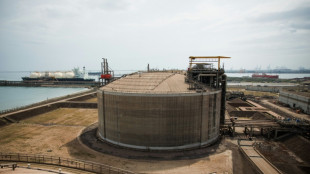
Global stocks mixed while oil prices jump on Hormuz / Photo: © AFP

Stock markets were little changed Monday, holding near record highs amid thin summer volumes, as investors awaited inflation data this week while mostly shrugging off the latest spike in oil prices.
Iran issued a litany of conditions to a potential reopening of the Strait of Hormuz. President Donald Trump responded by saying the United States would seek conflict compensation from Iran.
The back-and-forth sent oil prices about five percent higher, weighing on US equities but not prompting major selling. The broad-based S&P 500 finished down 0.1 percent
"Stocks are doing their best to ignore the situation in the Persian Gulf, which is frankly what they've been doing for the last few months," said Steve Sosnick of Interactive Brokers.
"We've noticed a pattern pretty much since the beginning of April that stocks will rally on anything that sounds like a positive development toward a ceasefire or a lasting peace, but not sell off when the bond market or the oil market express their disappointment with the lack of progress," Sosnick said.
In Europe, Paris and Frankfurt closed up marginally, while London slipped at the end of the session.
US stocks rose Friday after data surprisingly showed that 23,000 jobs were lost last month, confounding widespread expectations for growth and suggesting that the US Federal Reserve would hold off on raising borrowing costs to contain stubbornly high inflation.
The focus turns now to US consumer inflation data due Wednesday, followed by producer prices later in the week.
Sosnick described the market as "relatively directionless" as it awaits the inflation data.
Earlier in Asia, equities were boosted by technology shares following a volatile run in recent weeks, with Japanese and Korean chipmakers leading the charge.
Tokyo climbed more than two percent thanks to advances for Tokyo Electron and Advantest. Seoul, Hong Kong, Shanghai and Mumbai also closed higher.
On currency markets, the dollar was mixed but clawed back losses against some currencies from Friday in reaction to US jobs figures.
The greenback plunged against the yen earlier this month when the US and Japanese monetary authorities jointly intervened in the market to support the Japanese currency, saying its value had fallen too far. But the dollar advanced on Monday against the yen.
The risk that oil prices will stay high or go up more looms as a potential risk to the yen, according to a note from Fawad Razaqzada of Forex.com.
"A prolonged disruption to energy flows should keep the inflationary pressures elevated," Razaqzada wrote. "That could make it harder for the Fed to ease policy, even if we see further data weakness, potentially providing an underlying source of support for the greenback."
- Key figures around 2020 GMT -
New York - DOW: DOWN 0.1 percent at 53,975.98 (close)
New York - S&P 500: DOWN 0.1 percent at 7,753.11 (close)
New York - Nasdaq Composite: DOWN 0.3 percent at 26,605.36 (close)
London - FTSE 100: DOWN 0.4 percent at 10,862.50 (close)
Paris - CAC 40: UP 0.1 percent at 8,726.03 (close)
Frankfurt - DAX: UP less than 0.1 percent at 26,323.88 (close)
Tokyo - Nikkei 225: UP 2.1 percent at 66,970.22 (close)
Hong Kong - Hang Seng Index: UP 1.1 percent at 25,937.49 (close)
Shanghai - Composite: UP 0.7 percent at 3,966.59 (close)
Euro/dollar: DOWN at $1.1543 from $1.1559 on Friday
Pound/dollar: UP at $1.3508 from $1.3491
Dollar/yen: UP at 159.31 yen from 157.76 yen
Euro/pound: DOWN at 85.45 pence from 85.67 pence
Brent North Sea Crude: UP 5.0 percent at $87.72 per barrel
West Texas Intermediate: UP 5.1 percent at $82.13 per barrel
Q.al-Mutawa--BT