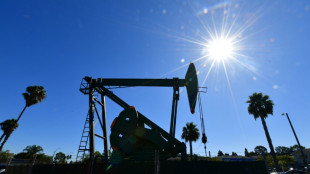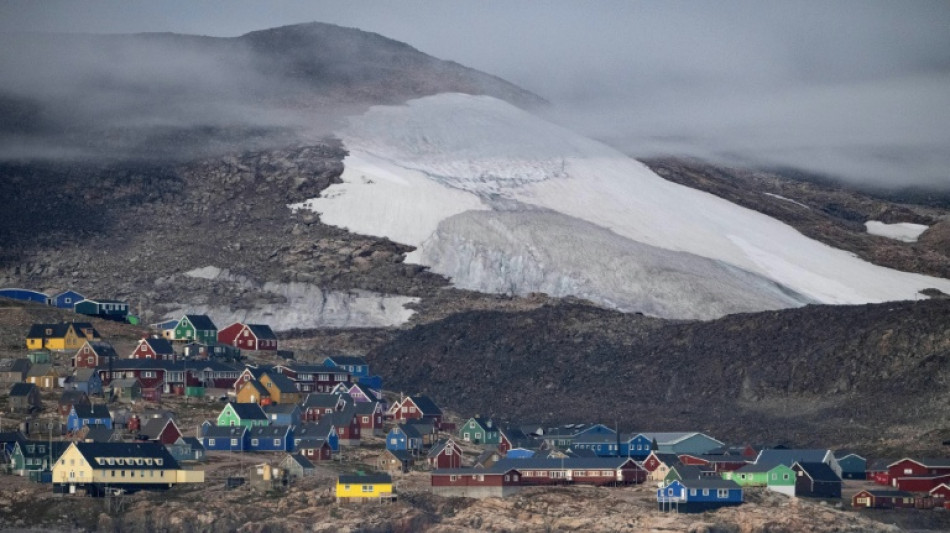
US company stokes Greenland tensions by unloading drilling gear / Photo: © AFP

A US energy exploration company has sparked an outcry by unloading drilling equipment without authorisation on the east coast of Greenland, the autonomous Danish territory coveted by US President Donald Trump.
Texas-based Greenland Energy, which insists it has no connection to the US president's territorial ambitions, maintains that it was merely taking a preliminary step toward exploration activities when it unloaded the gear last month in Nunap Qeqqa, also known as Jameson Land.
Greenland Energy did not respond to an AFP request for comment, but it told Danish media in July that it believed that authorisation to unload and store its equipment, which was located in another part of Greenland, was only required within the oil exploration licence area.
"It was a mistake on our part, a mistake that will not be repeated," its managing director Roderick McIllree told Danish public broadcaster DR in late July.
The equipment is currently stored in a hangar at Nerlerit Inaat Airport, near the village of Ittoqqortoormiit, the closest settlement to the licence area.
The company has received a "strong warning" from the Greenland government, which in a statement last month added "that all future logistical arrangements must be notified to and approved by the mineral resources authority before they are carried out".
Greenland Energy's chairman, Larry Swets, has been described as being close to Trump.
And at a time when the US president still wishes to control the vast Arctic island, the prospect of a US energy company potentially carrying out exploration activities is making people uneasy.
"There is this vague sense of a connection to Trump," Ulrik Pram Gad, a researcher at the Danish Institute for International Studies, told AFP.
- 'Anxiety' -
"This creates anxiety and tensions, all the more so because with Trump you can expect anything," he added.
"With this unauthorised unloading of equipment, the company has really not improved its chances with the Greenland authorities," said Anne Merrild, a professor at Aalborg University and Arctic specialist.
In 2021, the Greenlandic government, which manages the island's natural resources, declared a moratorium on the exploration and extraction of oil across the Arctic territory, which has been profoundly disrupted by climate change.
But the exploration licences under which Greenland Energy operates were issued earlier, in 2015 and 2018, and therefore remain valid.
"One of the conditions for keeping the licence is to actively explore the area," Pram Gad pointed out, while noting that "the company is under pressure", as it is not active currently.
Activities are subject to specific permits, and Greenland Energy still hopes to obtain full approval to begin drilling soon in order to determine the quality of potential deposits.
There is a need to double down on preparations and equipment on land that is inherently hostile due to the harsh Arctic conditions.
"We continue to be encouraged by the progress being made toward the remaining approvals required for drilling," Greenland Energy said in a letter to shareholders.
Greenland's government is less optimistic.
"Given the current situation, I do not consider it realistic that the company can drill in the autumn," Greenland Foreign Minister Mute Egede, who is responsible for natural resources, told the territory's broadcaster, KNR.
- Global tensions -
The environmental and social impact studies required to approve the project have not yet been submitted, the Greenland government has noted.
"The few inhabitants of the region depend on the surrounding nature: they are hunters, fishers,” Merrild explained.
"Drilling causes a lot of disturbance, and increased human activity would have an impact on wildlife."
In Ittoqqortoormiit, more than a hundred people -- out of the 325 inhabitants of the village -- demonstrated in mid-July against the project, according to KNR.
The geological survey of Denmark and Greenland (GEUS) estimates that the region could contain the equivalent of 2.35 billion barrels of oil, a considerable volume for a single oil project, but limited when compared with reserves around the globe.
"In the company's logic, given current geopolitical tensions, the project sends a signal; it's a way of saying 'we have access to resources elsewhere'," Merrild stressed.
B.al-Rayes--BT