Americans impacted by climate change demand answers from lawmakers / Photo: © AFP
Some vote Republican, others Democrat. They are retirees, barely adults, or accompanied by young children.
And all are scarred by natural disasters that are becoming all too frequent as the world heats up.
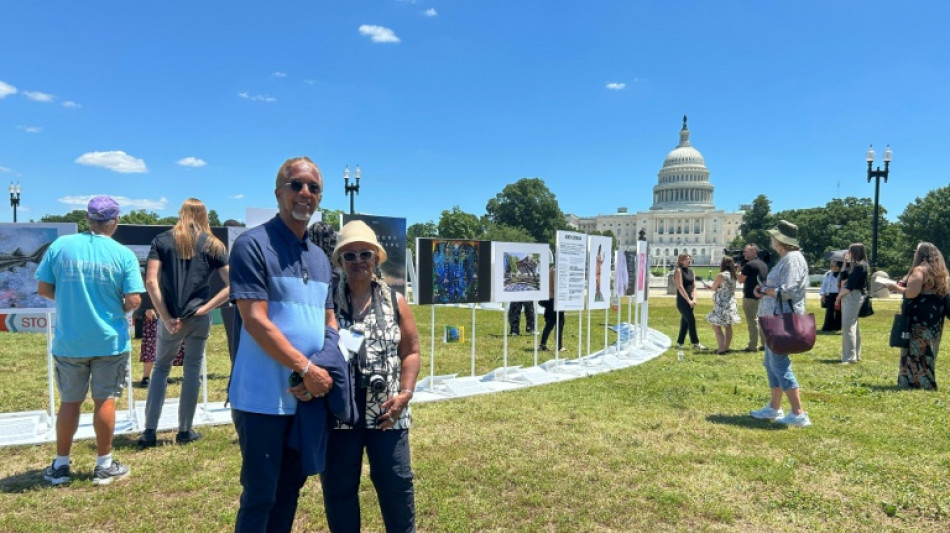
Dozens of Americans hailing from across the country including states like Hawaii, Louisiana and Vermont descended on Washington this week as part of the organization "Extreme Weather Survivors," a group noteworthy not least for its diverse makeup.
Among them is Gayle Nicholls-Ali, who lost her home more than a year ago in the fires that devastated Los Angeles.
But she and her husband Rasheed remain mired in red tape, unable to begin rebuilding.
"It's just been one disappointment after another," the 69-year-old told AFP, having ventured with some 70 others to the nation's capitol to meet with congressional representatives.
"We thought they would protect us," she said. "Not at all."
The group gathered in Washington to meet with lawmakers and express concern over the government's lack of preparations against the immediate and future threats of climate change.
Kylie Nidever, 36, saw her neighborhood ravaged by catastrophic floods in central Texas that killed 135 people, including many children.
"You wouldn't necessarily think that a flood survivor and a fire survivor have things in common," she told AFP.
"But we absolutely do."
- Feeling of abandonment -
The group's discussions see the same patterns keep cropping up.
People share accounts of overwhelmed emergency services, and a feeling that public authorities have abandoned them.
They speak of a lack of aid, which often means reconstruction in the wake of disasters proves impossible.
And there is simmering anger.
"How do you respond to people who say, 'This is just the weather?'" asked a participant during one such discussion.
"I just want to slap their face."
And a fire survivor sitting nearby, his voice raspy, says he finds it all "terrifying" because "every story is the same."
There is a persistent fear among members of the group that these scenarios will play out again and again.
They agree that climate change is making these weather extremes more frequent and more intense.
About a decade ago such events causing more than $1 billion in damages happened approximately once every 2.7 months in the US, according to the organization Climate Central.
Now they're happening about every two weeks.
"If recovery takes years and these events happen more and more and more... what does that mean for our country?" asked Sierra Lindsey Kos, the co-founder of Extreme Weather Survivors.
- 'We can be resilient' -
The situation is all the more concerning given that the US president, Donald Trump, is an avowed skeptic of climate change.
Since returning to the White House, he has cut funding for climate research and natural disaster response and prevention.
"We have to continue to do more, because at this point we're all at risk," Jessica Calix, 41, told AFP.
She lost her San Diego home in a flood in January 2024, and ever since has lived with her son in a trailer.
The group draws inspiration from organizations whose members have suffered the impacts of gun violence.
They hope to drive change by raising public awareness and pressuring policymakers.
"We can't change bad things that have already happened. I don't think we can stop climate change from happening at this point, which is deeply unfortunate, but we can be resilient and not bury our heads in the sand," said Amy Dishion, 41.
Her husband died at just 32 years old of heat stroke during a period of extreme temperatures.
"We can help each other as communities and at the policy level, and we can actually still create policies to combat climate change," she told AFP, "so that the worst of what could happen will not happen".
H.al-Zayani--BT