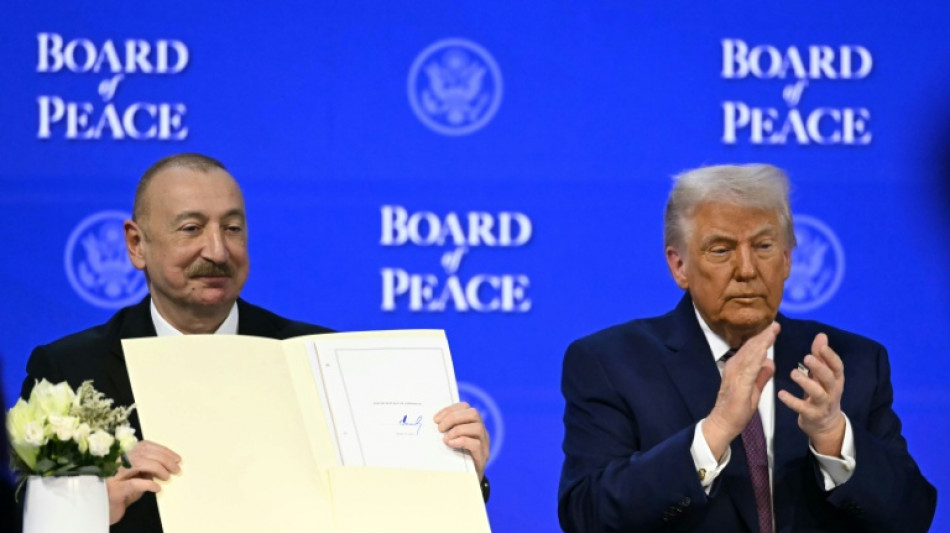
With 'Board of Peace,' Trump tries hand at institution-making, to wide doubt / Photo: © AFP
After a year of tearing down global norms and withdrawing from UN bodies, US President Donald Trump is trying his hand at international institution building with his self-styled "Board of Peace" -- to wide skepticism.
Unlike the United Nations, where every member has a say and five big powers wield vetoes, the nascent board is unambiguously led not just by the United States but personally by Trump, who will hold final say and can remain in charge past his presidency.
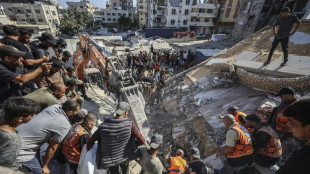
Trump first conceived of the board for Gaza, where Israel and Hamas agreed to a US-backed ceasefire in October.
But Trump quickly raised eyebrows by sending out wide invitations including to Russian President Vladimir Putin, whose Ukraine invasion Trump has failed to stop, and to countries far removed from traditional Middle East diplomacy.
Launching the board at the World Economic Forum in the Swiss resort of Davos, Trump said the new body could "spread out to other things as we succeed with Gaza," with Secretary of State Marco Rubio saying the "possibilities are endless."
Trump boasts of ending eight wars in his year back in office -- a claim viewed by many as overstated -- and has loudly complained about not receiving the Nobel Peace Prize.
In Davos, Trump said he envisioned his board playing a role "coupled with the United Nations" but again bashed the global institution, to which he has ordered major US cuts.
"On the eight wars that I ended, I never spoke to the United Nations about any of them -- and you would think that I should have," he said.
Also raising suspicion is the question of money, as Trump already faces allegations of self-enrichment from the presidency.
The board's charter says that members of the executive board will pay $1 billion for a permanent spot.
A US official clarified that members would not have to fork over the massive sum for a temporary two-year stint on the board and promised "highest financial controls and oversight mechanisms," although where the money will actually go remains unclear.
- 'Galaxy far, far away' from reality -
Major European nations have shunned the board, which is heavy on longstanding US partners in the Middle East, ideological allies of Trump and smaller countries eager for Trump's attention.
"This thing doesn't have the bandwidth and doesn't have the set of guiding principles that would enable serious countries to join," said Aaron David Miller, a former US Middle East negotiator now at the Carnegie Endowment for International Peace.
He said Trump felt emboldened after ordering the US raid that seized Venezuelan leader Nicolas Maduro on January 3, and was convinced that existing global institutions "don't understand that the central driving feature of the international system today is US power."
The board is "tethered to a galaxy far, far away and not to the realities of conflict resolution back here on Planet Earth," he said.
Britain has historically been among the most eager to sign on to US initiatives, but Foreign Secretary Yvette Cooper said in a BBC interview there was a "huge amount of work to do" and questioned inviting Putin.
France has made clear it will not join, leading Trump to threaten a 200 percent tariff on French wine unless President Emmanuel Macron joins the voluntary board.
A group of Muslim-majority countries -- Saudi Arabia, Turkey, Egypt, Jordan, Indonesia, Pakistan, Qatar and the United Arab Emirates -- welcomed the board but in a joint statement highlighted that it should be a "transitional administration" for Gaza.
Richard Gowan, program director for global issues and institutions at the International Crisis Group, said the "Board of Peace" offered a sign of how Trump wants to pursue diplomacy in his remaining three years in office.
"He seems to be putting the boot into existing multilateral institutions like the United Nations and switching to his own boutique organization that he can control completely," Gowan said.
But he noted that the board's first task was Gaza, where Trump has proposed glitzy development but which lies in rubble with a fragile ceasefire.
"If Gaza implodes, the Board won't have a lot of credibility elsewhere."
L.al-Samahiji--BT