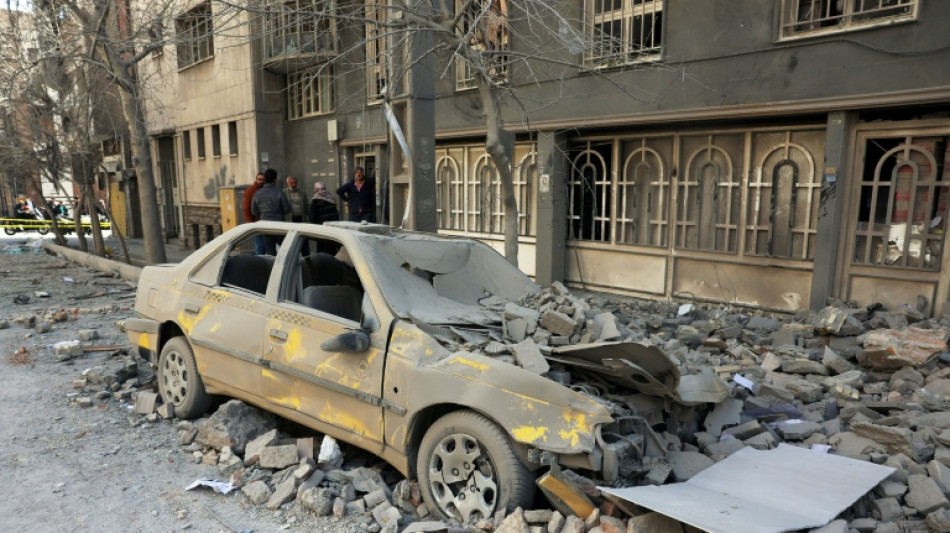
Sleepless Iranians count cost of war as damage mounts / Photo: © AFP
As US and Israeli war planes pummel Iran with daily strikes, witnesses say that civilian deaths, damage to infrastructure and anxiety are mounting while security forces remain an intimidating presence on the streets.
Millions of Tehran residents spent another stressful night on Thursday-Friday as huge explosions shook the city and lit up the sky, making it impossible for many to sleep, AFP correspondents said.
Israel and the United States insist they are focusing on military, police and administrative targets with high-precision munitions, seeking to undermine the Islamic Republic's clerical government that both sides would like to see fall.
"I don't think anyone who hasn't experienced war would understand it," a terrified 26-year-old teacher told AFP on condition of anonymity. "When you hear the bombs, you have no idea where they will hit."
Robert, a 60-year-old businessman from Tehran, told AFP that life in the capital was "really very scary" with fresh explosions and the roar of fighter jet engines reported again on Friday.
"People are frightened," he told AFP as he crossed into Armenia at the Agarak/Norduz border crossing.
Verifying damage to housing and civilian infrastructure, as well as civilian deaths, is difficult inside Iran, where the few independent news organisations authorised to work there, including AFP, are subject to tight controls.
The health ministry puts the death toll after seven days of war at 926, with around 6,000 injured -- numbers that AFP could not independently verify.
Government spokesman Fatemeh Mohajerani said Friday that 3,090 homes and 528 commercial properties had been damaged.
AFP photographs and video emerging from Tehran, taken together with testimony from witnesses inside the country or crossing the borders, also provide a window into the destruction.
Some claims from witnesses, including alleged strikes on civilian targets, cannot be confirmed, but the intensity and geographic spread of the bombardment that has encompassed small towns and regional cities is in no doubt.
"This war cannot be compared with the previous war," said Faiz Mohammad Rahimi, an Afghan man who fled Tehran, referring to the 12-day conflict between Israel and Iran last June.
"They are hitting everywhere, both residential places and government places," the 40-year-old told AFP after crossing back into his homeland at the Islam Qala border point.
Iranian foreign ministry spokesman Esmaeil Baqaei has accused the US and Israel of "deliberately target(ing) civilian areas and any location they believe will inflict the maximum possible suffering and loss of life."
- News blackout -
On Friday, footage emerged of the smouldering and ruined 12,000-seat Azadi Indoor Stadium in Tehran.
Homes, apartment blocks and shops around targeted sites also appear to be sustaining major damage, given the force of the explosions in sometimes densely populated areas.
The high-end private Gandhi Hospital in northwest Tehran had its windows blown out in the first days of the war, one of 13 hospitals to have sustained damage, according to the World Health Organisation.
The biggest single loss of life is believed to have taken place at an elementary school in Minab in southern Iran where Iranian officials say that 150 people, including many children, were killed on Saturday.
AFP could not access the site or obtain independent confirmation of the toll. Neither the United States nor Israel has claimed responsibility for the strike.
A New York Times investigation concluded that the US was most likely responsible.
The Pentagon has confirmed it is investigating the attack, while Secretary of State Marco Rubio said the US would "not deliberately target a school."
Overseas human rights groups, a vital source of credible information about life inside Iran, say they too are struggling to confirm deaths and injuries because of an internet blackout and phone connectivity problems.
"Confirming the identities and getting statistics on data on the casualties has been really challenging for us," Awyar Shekhi, a member of the Norway-based Hengaw Organisation for Human Rights, told AFP.
On the streets, Iranian police and security forces, many in plain-clothes, are out in force.
adp-burs/dl
D.al-Mohammed--BT