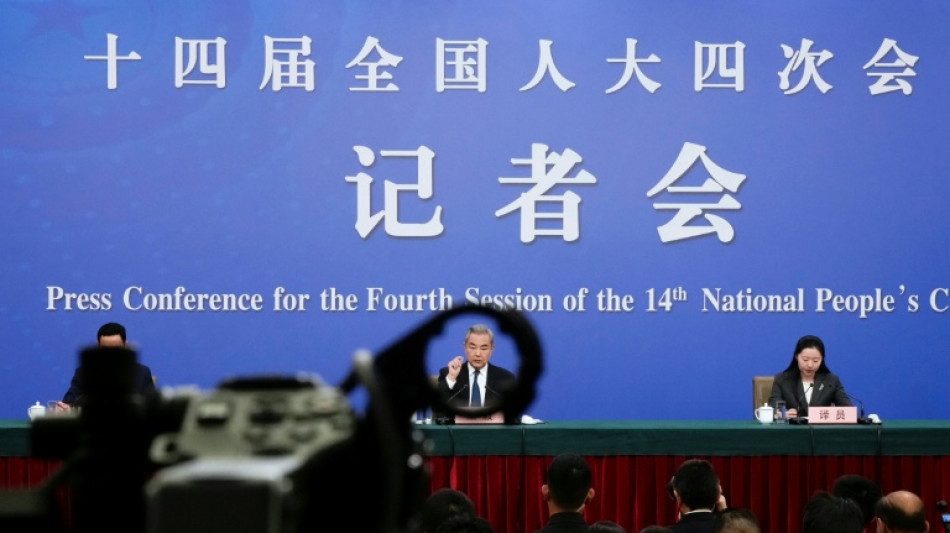
China FM urges US to manage differences in face of trade woes / Photo: © POOL/AFP
China's top diplomat urged the United States Sunday to iron out its differences with Beijing, as the world's two largest economies lock horns over trade tariffs and geopolitical issues.
Ties between China and the United States have been strained since US President Donald Trump returned to the White House last year, followed by a trade war that saw the two countries impose tariffs on each other's products.
While the US-China trade war has uprooted the global economy, Beijing has sought to profit off Trump's mercurial policies by positioning itself as a reliable alternative partner.
"We observe a certain country erecting tariff barriers and pursuing decoupling and supply chain disruption," Wang told a press conference on Sunday.
"These actions are akin to trying to extinguish a fire with fuel. Ultimately, they will backfire."
He was speaking during China's annual political gathering, which began this week, known as the "Two Sessions".
The parallel meetings of China's parliament and political consultative body are closely watched for clues as to the priorities of China's leaders in the face of a precarious geopolitical landscape.
Wang addressed a range of issues, including the US-China relationship, tensions in the South China Sea, as well as wars in the Middle East and Ukraine.
"This year is indeed a big year for Sino-US relations," Wang told reporters.
While China and the United States "cannot change each other", he said, adding "we can change the way we interact with each other".
Wang urged both sides to "manage existing differences and eliminate unnecessary interference".
- Middle East war -
But a wide range of disagreements remain.
Beijing has blasted US and Israeli military strikes on Iran, which sparked the war in the Middle East.
China has diplomatic and trade ties with Tehran, and has condemned the killing of Iran's supreme leader Ayatollah Ali Khamenei.
Wang said on Sunday the war "should never have happened".
"A strong fist does not mean strong reason. The world cannot return to the law of the jungle," he told reporters.
At the same time, he maintained that China's relations with Moscow, which have been criticised by Western countries for sustaining the war in Ukraine, remained "steadfast and unshakeable".
Beijing has sought to position itself as a neutral player in the Ukraine war, but Western leaders say China is supporting Moscow through imports and by helping the Kremlin to avoid sanctions.
- EU ties improving -
Leaders from France, Canada, Finland and the United Kingdom, among others, have flocked to Beijing, recoiling from Trump's bid to seize Greenland and tariff threats against fellow NATO members.
Wang welcomed the visits, saying "more and more insightful Europeans agree that China is not a competitor, but a global partner".
Relations between China and the European Union had seen "a steady improvement" in the last year, he told reporters.
In the spirit of warming relations, China has doled out visa-free travel agreements to around 50 countries and reduced tariffs on exports from Canada and the United Kingdom, among others.
- Taiwan 'red line' -
The issue of self-ruled Taiwan, however, remains a red line which threatens to worsen China's relationship with the United States.
Beijing views democratic Taiwan as part of its territory and has not ruled out taking it by force.
Trump has floated the idea of sending more US weapons to Taiwan despite warnings from China's leader Xi Jinping.
The two leaders are due to meet in Beijing in April.
Wang reiterated on Sunday that Beijing "will never allow anyone or any force to separate Taiwan... from China once again".
The issue has also caused a rift between China and Japan after Prime Minister Sanae Takaichi suggested in November that Tokyo could intervene militarily in any attack on the island.
L.al-Hashemi--BT