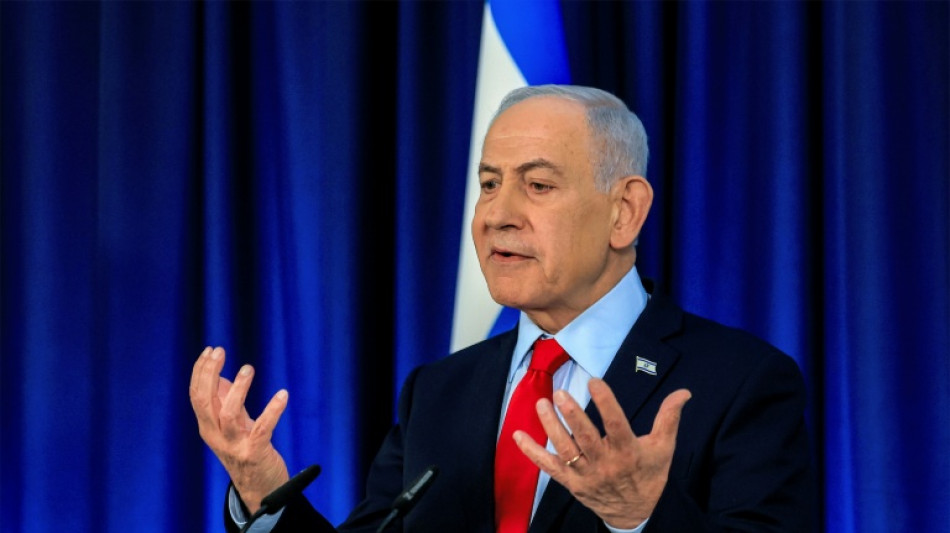
Stocks dip, oil calmer as Mideast war persists / Photo: © POOL/AFP

Stocks dipped and oil prices steadied Friday, at the end of a turbulent week in which attacks on Gulf energy infrastructure rattled global markets and sparked fears of an energy shock.
US President Donald Trump said Israeli forces would not target any more of Tehran's energy infrastructure, while Israeli Prime Minister Benjamin Netanyahu indicated the end of the fighting could be close.
"Some calm has descended on markets after a brutal week, but fears remain elevated about how economies will respond to an inflation shock sparked by rampant energy prices," said Susannah Streeter, chief investment strategist at Wealth Club.
European stock markets dipped around midday Friday, after heavy losses Thursday.
Wall Street ended lower Thursday despite a late rally, while Asian stock markets ended the week lower.
The dollar firmed against main rivals on Friday.
Disruption to energy supplies persisted as Kuwait reported a fire at its Mina Al-Ahmadi refinery, a day after a direct hit on Qatar's vital Ras Laffan facility.
Brent crude had soared to as high as $119 a barrel on Thursday after Tehran struck a number of energy sites around the Gulf in retaliation for Israel's attack on its South Pars field.
As the conflict drags on, equities remain sensitive to fears over global energy markets, with oil still holding around $100 a barrel amid the effective closure of the crucial Strait of Hormuz.
The European Central Bank on Thursday warned that the energy shock caused by the war would sharply push up inflation and hit eurozone growth.
Amid concerns over economic impacts of the war, the ECB, Bank of England and the US Federal Reserve all held interest rates steady this week, as did the Bank of Japan.
After the BoE flagged inflation risks, UK 10-year bond yields surged to the highest level since the 2008 global financial crisis.
Russia's central bank on Friday cut its key interest rate to 15 percent from 15.5 percent as the country's economy slows under pressure from Moscow's protracted and expensive war in Ukraine and Western sanctions.
At the same time, Russia's economic fortunes have been buoyed by surging oil prices triggered by the war in the Middle East.
Disruption to shipping through the Strait of Hormuz, through which a fifth of global oil and Liquefied Natural Gas (LNG) flows, remains a key driver of energy prices.
- Key figures at around 1115 GMT -
Brent North Sea Crude: UP 0.5 percent at $109.20 per barrel
West Texas Intermediate: DOWN 0.1 percent at $95.38 per barrel
London - FTSE 100: DOWN 0.1 percent at 10,055.35 points
Paris - CAC 40: DOWN 0.1 percent at 7,801.39
Frankfurt - DAX: DOWN 0.3 percent at 22,771.33
Hong Kong - Hang Seng Index: DOWN 0.9 percent at 25,277.32 (close)
Shanghai - Composite: DOWN 1.2 percent at 3,957.05 (close)
Tokyo - Nikkei 225: Closed for a holiday
New York - Dow: DOWN 0.4 percent at 46,021.43 (close)
Euro/dollar: DOWN at $1.1567 from $1.1583 on Thursday
Pound/dollar: DOWN at $1.3389 from $1.3425
Dollar/yen: UP at 158.54 yen from 157.65 yen
Euro/pound: UP at 86.39 pence from 86.23 pence
W.al-Qassim--BT