Iran ups threats over naval blockade, but still talking to US / Photo: © AFP

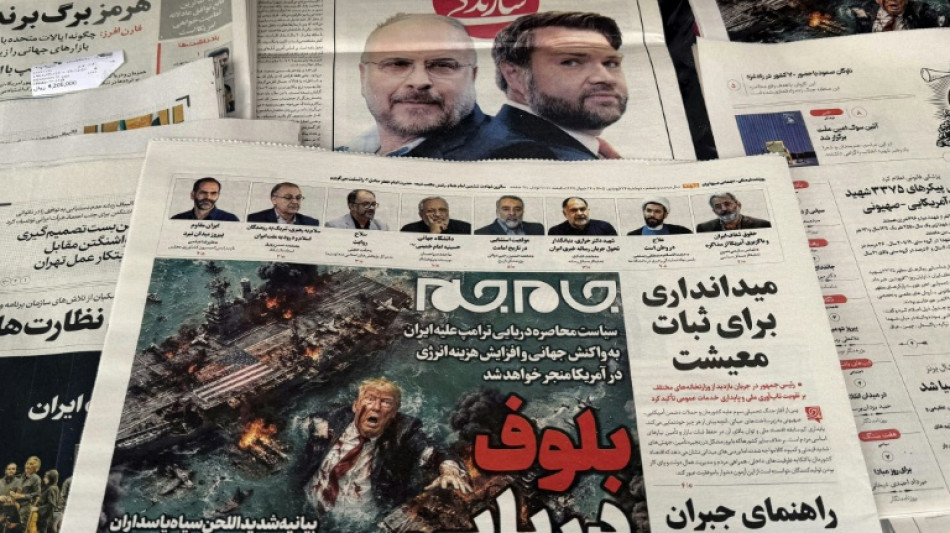
Iran's military threatened on Wednesday to shut down Red Sea trade unless the United States lifted its naval blockade on Tehran's ports, saying the ceasefire was at risk.
The warning came after President Donald Trump indicated peace negotiations could resume this week, and as Iran confirmed the sides had kept talking via Pakistan after a first round of negotiations fell flat.
US Vice President JD Vance, who led the weekend talks, said the Islamic republic was being offered a "grand bargain" to end the six-week war and address the decades-old dispute over Tehran's nuclear programme.
But for now, both sides seemed intent on keeping up the pressure.
Washington has sought to turn the screws on Tehran with a blockade of its ports, with US Central Command saying overnight that American forces "have completely halted economic trade going into and out of Iran by sea".
The picture based on recent maritime tracking data in the Strait of Hormuz was less clear-cut, and Iran's Tasnim news agency reported Wednesday that shipping had continued from southern Iran.
But the head of Iran's military central command centre warned a US failure to lift the blockade would constitute "a prelude" to violating the two-week ceasefire.
Unless Washington relents, Iran's armed forces "will not allow any exports or imports to continue in the Persian Gulf, the Sea of Oman and the Red Sea," said Ali Abdollahi.
- Pakistani delegation -
Speaking to the New York Post on Tuesday, Trump said a new round of talks with Iran could take place in Pakistan "over the next two days", while telling Fox Business the war was "very close to being over".
On the Iranian side, a foreign ministry spokesman said "several messages" had been exchanged via Islamabad since the talks wrapped up on Sunday, and that Tehran would "very likely" receive a Pakistani delegation on Wednesday.
Stocks rose and crude dropped on hopes for a deal to get oil flowing again through the Strait of Hormuz -- choked by Iranian forces since the US-Israeli offensive began in late February, and now the focus of the US blockade.
Analysts say Trump is aiming not only to cut off Iranian revenue but also to pressure China, the biggest buyer of Iran's oil, to push it to reopen the strait.
In a nod to China's potentially key role, Trump told Fox Business he had written to Xi Jinping asking him not to supply weapons to Tehran, and received the Chinese leader's assurances that he was not doing so.
- 'Grand bargain' -
Trump has insisted any deal must permanently bar Iran from becoming nuclear-armed. He launched the war on February 28 arguing that Tehran was rushing to complete an atomic bomb, an assertion not backed by the UN nuclear watchdog.
Reports said the United States had sought a 20-year suspension of Iran's uranium enrichment programme during the Islamabad talks, and that Iran, in turn, proposed suspending its nuclear activity for five years -- an offer US officials rejected.
Tehran has always insisted its nuclear programme is for civilian purposes and its foreign ministry spokesman said Wednesday that Iran's right to enrich uranium was "indisputable", although the level of enrichment was "negotiable".
At an event in the US state of Georgia on Tuesday, the US vice president said Trump had pledged to "make Iran thrive" if it committed to "not having a nuclear weapon".
"That's the kind of Trumpian grand bargain that the president has put on the table," Vance said, adding: "Man, we're going to keep on negotiating and try to make it happen."
- Twin track diplomacy -
The latest signals on US-Iran talks came as Israel and Lebanon also agreed to open direct negotiations after holding their first high-level face-to-face meeting since 1993 on Tuesday in Washington.
Trump's administration is pressing hard for an end to the conflict between Israel and Iran-backed Hezbollah in Lebanon, fearing it could jeopardise a broader settlement.
The US State Department said "all sides agreed to launch direct negotiations at a mutually agreed time and venue".
But the diplomatic push remained fragile, with the Israeli military saying it had struck more than 200 Hezbollah targets in Lebanon in the past 24 hours, while the militant group, which is hostile to any talks, fired dozens of rockets at Israel.
burs-ec/amj
M.al-Mannai--BT