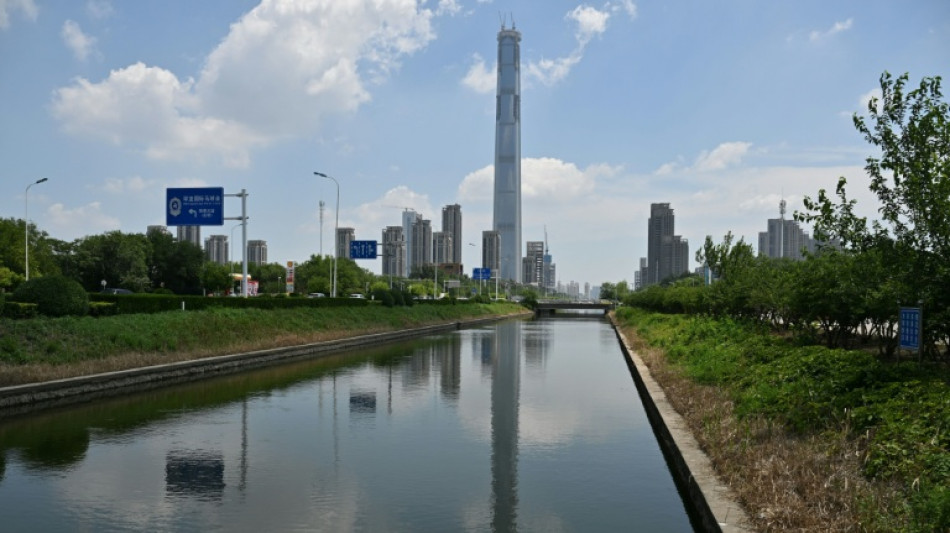
Empty skyscrapers: China's property slump still throttling growth / Photo: © AFP
The world's tallest unoccupied skyscraper was meant to boast a rooftop pool and a luxury hotel after completion, but instead it has stood deserted in the Chinese port city of Tianjin for years.
Work on the soaring Goldin Finance 117 began in 2008, but construction stalled as its developer fell into debt and the tower remains unfinished 18 years on.
The 595.5-metre (1,954-foot) skyscraper is emblematic of the years-long crisis that has left Chinese cities dotted with abandoned high-rises and residential towers.
China's property market was once a key driver of national growth, but has become a stumbling block.
The economy expanded by 4.3 percent year-on-year in the second quarter -- its weakest pace in more than three years, according to government data on Wednesday.
At the foot of the skyscraper, construction workers wearing brightly coloured vests and hard hats took their lunch breaks.
"It required too much funding... the amount of capital needed was just too large," a worker involved in the project told AFP on Tuesday.
"But once it is built and finished, with the interior completed and the lights installed, it will look even more beautiful at night," the worker added.
Parts of the eastern side of the building were still exposed when AFP visited, with cranes at the top.
- Investment plummeting -
Construction on the skyscraper halted after its Hong Kong-based developer Goldin Properties ran into financial trouble following the 2015 Chinese stock market crash.
Real estate giants such as Evergrande, Country Garden and Vanke have also been plagued by debt struggles since 2020, when authorities narrowed access to credit in a bid to curb excessive borrowing and speculation.
The property crisis drags on and home prices have stagnated, dissuading would-be buyers.
Investment in real estate development across the country saw an 18 percent drop year-on-year between January to June, according to official data, with residential investment falling 17.8 percent.
In March, Chinese authorities banned entombing cremated remains in empty apartments, a practice that took off as mourners tried to dodge rising funeral costs.
Economists have argued that China must shift towards a growth model powered more by domestic consumption than by investment in real estate and infrastructure.
Construction on the Tianjin skyscraper resumed in April 2025, with state media saying in March that workers were installing a diamond-shaped crown -- what appeared to be the project's finishing touches.
"Significant phased progress has been achieved in efforts to revitalise... the project," state news agency Xinhua reported.
Leasing has been largely completed, with seven state-owned enterprises and 10 private firms set to purchase space and move in, it added.
That means the Goldin Finance 117 may soon ditch its status as "tallest unoccupied building", as declared by Guinness World Records in 2015.
- Ghost cities -
Local media outlets say the tower should be completed in the first half of 2027.
The resumption of work last year followed the "bankruptcy liquidation case of a real estate company" and after Tianjin courts "disposed of the relevant land use rights and projects under construction", Xinhua said, seemingly referring to Goldin.
Vacant apartment complexes dubbed "ghost cities" have sparked debate on Chinese social media about the impact of speculative buying and the country's real estate excesses.
The sector's crisis is amplified by "a heavy debt-fuelled structure and the belief that real estate prices will always go up", said Gary Ng, senior Asia Pacific economist at Natixis.
"Developers find it difficult to pay suppliers and finish the projects before even selling or renting out the units," Ng told AFP.
Ng said Beijing would have made "bigger" policy moves if it really wanted to prop up the real estate market.
"As long as it does not pose systemic risks, the government is happy to stabilise the market and gradually let other sectors play a more important role in the economy," Ng added.
"Property is no longer the policy priority."
Tianjin resident Zhang, who works near the tower, told AFP his neighbourhood had "20-plus-storey" buildings which have been "sitting unfinished".
Seeing the Tianjin tower finally completed, the 18-year-old said, would be "pretty nice".
Y.al-Turki--BT