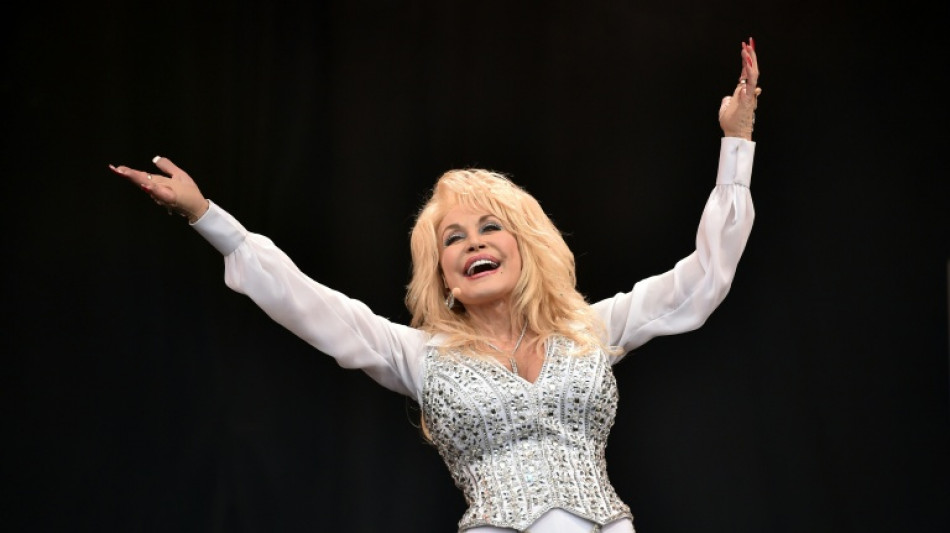
US LGBTQ community mourns 'diva' Dolly Parton / Photo: © AFP/File

At a Washington gay bar, Cameron Austin donned a country western outfit replete with cowboy boots, as he sat in the corner sipping a drink while Dolly Parton's "When I'm Gone" blasted through the sound system.
"I didn't grow up listening to a lot of the gay icons that we typically think of, but she's the one that's been with me from the very start," the 28-year-old east Tennessee native said at a party honoring the country superstar on Tuesday night.
"Dolly was always there for me."
In death, just as in life, Dolly Parton was a rare unifier in a highly polarized America.
Her legacy is being celebrated by the Trump-controlled White House, honky-tonks across the largely conservative US south, and -- especially -- in America's gay bars.
In the rhinestone-clad, quick-witted country music queen, many gays and lesbians saw an unexpected but unwavering ally that advocated for their dignity and rights long before it was popular to do so.
"I think she just defied expectations in a lot of ways...I think when a lot of us have families that we might not have the best relationships with -- that might be southern or might be religious -- the fact that someone can come from those same places and be accepting, makes us long for something that we might not have ever had," Austin told AFP.
- 'I accept them' -
Climbing out of grinding poverty in rural Appalachia, Parton seemingly never planned on becoming a gay icon, but it is a role she fully embraced -- showing particular affection for drag performers.
She once quietly entered a Dolly Parton drag queen look-alike contest -- and lost.
"I just got in the line, and I just walked across, and they just thought I was some short little gay guy, and I got the least applause," Parton told ABC News in 2012 amid giggles. "But I was just dying laughing inside."
"I say it's a good thing I was a girl or I'd be a drag queen," she added.
Her 1991 song, "Family," explicitly called for gay tolerance, as the AIDS crisis ravaged and stigmatized the community.
In contrast to her boisterous outward appearance, Parton was notably reserved on other issues of day-to-day politics, citing a fanbase of all political stripes.
But she wrapped her LGBTQ advocacy in the moral language of the US south.
"I think I've always been accepted in the gay community because I accept them," Parton once told CNN. "They know that I'm not judging them. I think people are who they are, and I'm not God, I'm not a judge. We're supposed to love each other exactly for who and what we are."
Nadine Hubbs, a professor of women's and gender studies and music at the University of Michigan said that it was Parton's religious upbringing that shaped her affectionate views towards the LGBTQ community, rather than driving her away from them.
"Her grandfather was a Pentecostal preacher, and she grew up singing in that church, and always spoke very clearly about her faith," Hubbs, who authored the book "Rednecks, Queers, and Country Music," told AFP.
"Dolly modeled how you could not only be loving and accepting of others and of yourself, but to do so within a deeply Christian framework," which had unique appeal in the deeply religious south, Hubbs said.
But Parton also kept it light-hearted.
In a 2019 appearance on late night television, she swapped the famous lyrics of her song "Jolene" to "Drag queen! Drag queen!"
In 2023, when Texas politicians sought to criminalize many drag performances, Parton backed a drag queen fighting the legislation in a way that was uniquely Dolly.
Brigitte Bandit, a 34-year-old drag queen in Austin, Texas who wished to only be identified by her stage name, took a children's book about Parton to the Texas state capitol, where she testified against the bill.
"I felt that was very relatable as a drag queen and so I took that book up there to testify," Bandit told AFP.
Parton later quietly organized for Bandit to be surpised with a custom acoustic guitar, bedazzled with rhinestones and the words "To Brigitte, Love Dolly" scribbled across it.
"She is a diva," Bandit said, adding that she hoped people would "take a minute to listen to her message, and be a little bit more like Dolly."
X.al-Zamel--BT