Far-right influencer shows Israel's coarse political turn / Photo: © AFP

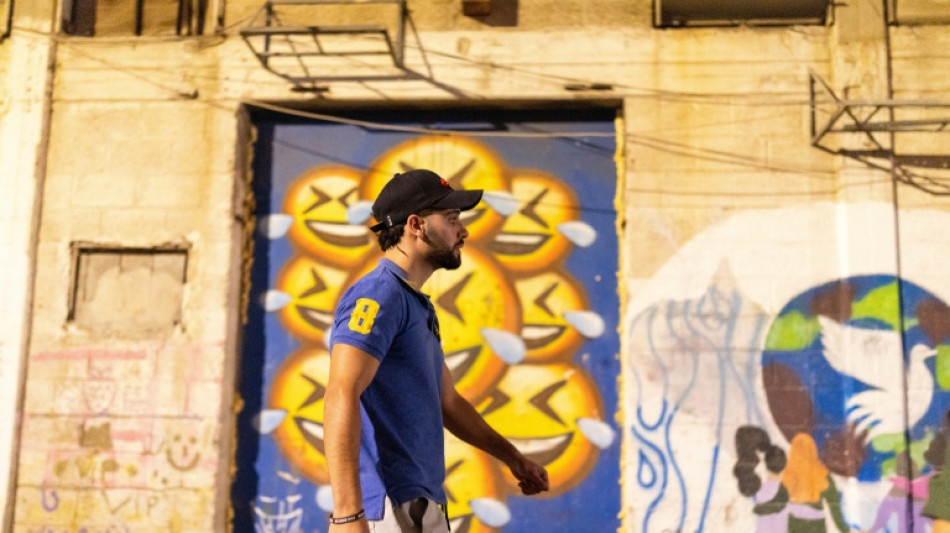
Sporting a baseball cap and brandishing his smartphone like a weapon, Mordechai David dedicates his time to filming people against their will.
On a recent day, his target was the family of an Israeli filmmaker whose documentary "NAZA", which won plaudits at the Venice Film Festival, severely criticises Israel's conduct in the war in Gaza.
"You are not welcome!" he shouted in a megaphone as he livestreamed footage of dozens of fellow demonstrators outside the home of the parents of Rachel Szor, who co-directed the film with Yuval Abraham.
The 27-year-old David is one of the most striking figures driving a coarsening of the political discourse in Israel, which holds elections on October 27 that will be a verdict on Prime Minister Benjamin Netanyahu and his hard-right government.
David's speciality is tracking down and publicly berating left-wingers or others considered "unpatriotic" and then posting everything online, much to the delight of his 150,000 social media followers.
"Social media can be stronger than television," David told AFP in a rare interview.
"This very week I posted a few videos that got more than one million views."
His targets, whom he peppers with insults, have included Lucy Aharish, an Israeli Arab who made history as the first Muslim anchor on Hebrew-language television, and Aharon Barak, a 90-year-old former Supreme Court president and outspoken critic of the government's judicial reforms.
"Age doesn't get you a free pass," David said, likening the judge to Iran's former supreme leader Ayatollah Ali Khamenei, who was killed in an Israeli attack earlier this year.
David accused the retired judge of "taking control of the State of Israel", a hyperbolic charge that echoes Netanyahu's campaign against the judiciary as he faces charges of corruption.
- Channelling anger -
As in many nations, a growing number of Israelis, especially the young, have pivoted away from traditional media in favour of online influencers promoting provocative, ideological messages.
In Israel, the divisions are especially acute. The country held five elections between 2019 and 2022.
This month's vote will be the first since the trauma of October 7, 2023, when Hamas carried out the deadliest attack ever against Israel.
Achiya Schatz, founder of the research group Fake Reporter that tracks online debates and disinformation, said David showed "the level of polarisation in Israeli society and the way in which belligerence" has been normalised.
"A significant section of the Israeli right wing feels ignored and sidelined," he said.
"Mordechai David channels their belligerence into political expression and entertainment."
David has faced repeated complaints that his visual clips amount to harassment.
His infamous behaviour has made him a darling of Channel 14, a television network close to the ruling right-wing coalition.
David is closely aligned with Itamar Ben Gvir, the far-right national security minister who has raised his own profile with violent statements including calls for the killings of Palestinians.
Ben Gvir has recruited David as part of his campaign team, filming content that has ensured a fan base for the 50-year-old Jewish supremacist among young voters.
David got his start as an ordinary counter-protester during the mass movement before October 7 against a judicial overhaul planned by Netanyahu, who has sought to decrease judges' independence.
After the attack, he gained notoriety by aggressively infiltrating demonstrations in support of the release of hostages in Gaza, denouncing Israelis who would have ended the devastating war in Gaza early for the sake of the captives.
David proved "his instinct for showmanship", Schatz said.
But his content can often diverge sharply from reality.
- Feeding polemic -
In mid-September, days before the Jewish New Year, in Tel Aviv's bustling Dizengoff Square, David ostentatiously tried to organise a prayer session separating men and women.
Gender segregation is standard practice for many Orthodox Jews but is forbidden in public places by the government of socially liberal Tel Aviv.
David approached women on the street inviting them to the women-only section. As they refused, he filmed their reactions. In the end only about 20 men participated, with police keeping a close watch.
When police intervened to take down the gender-segregation barriers, a brief commotion broke out as the men booed.
But when David posted the scene several hours later, the editing gave viewers the impression of a major clash -- a violent confrontation in Israel's secular heart.
"You just need a few people to create an incident that generates 10 videos, hundreds of posts, television coverage and several days of political polemic," Shatz said.
"The physical event is just the backdrop. The real audience is online."
J.al-Balooshi--BT