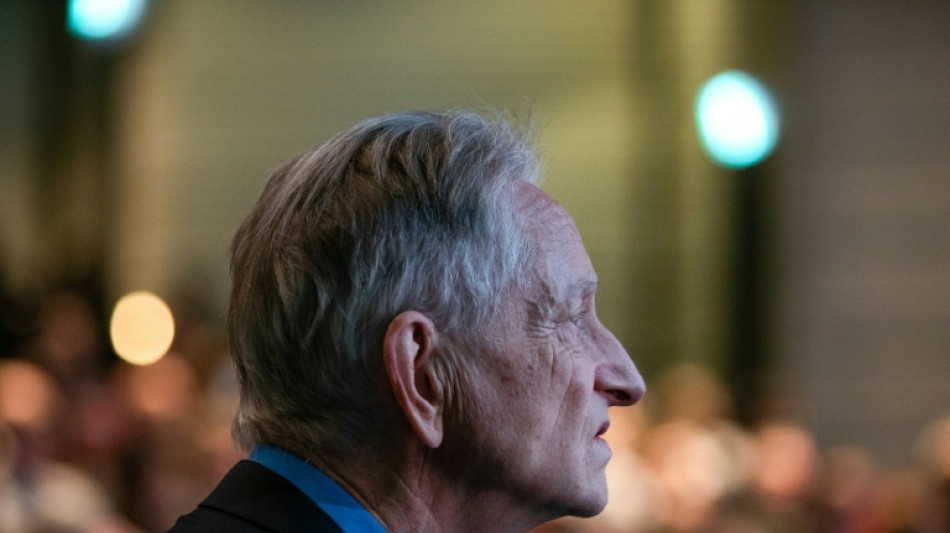
Unregulated AI like speeding with no steering wheel: AI godfather Hinton / Photo: © AFP

Artificial Intelligence pioneer Geoffrey Hinton insisted Tuesday on the need to strictly regulate the technology, warning that it remained unclear if humanity could co-exist with super intelligent AI.
Hinton, considered the "Godfather of AI", told the 2026 Digital World Conference in Geneva that there was a dire need to strengthen governance frameworks and ethical safeguards around the technology.
But, he warned via video link, huge investments were going into convincing the public that regulating the technology was akin to slowing down progress.
Those opposed to regulation say "unregulated AI is like the accelerator, and regulation is like a brake", said the British-Canadian computer scientist who won the 2024 Nobel Physics Prize for his work on AI.
"They want a very fast car with no steering wheel," he said.
His comments came at the end of the day-long Geneva conference on the importance of international cooperation in shaping the social dimensions of AI.
The participants raised concerns over how global debates on AI remain largely driven by technical advances and commercial applications, with less focus on social impacts in areas including labour markets, inequality and public services.
Hinton warned about the impact AI will have on job losses.
The technology can certainly improve productivity in areas like health care, where there is always a need for more.
But in other sectors, like call centres, AI can already do the jobs as well as people and soon will do it better, he said, saying it was clear that no amount of re-training will counter that.
And "if we get super intelligent AI, any intellectual job it will be able to do," he said, meaning that "even if new jobs are created, AI will be a cheaper way to do them".
Hinton, who made headlines when he quit Google in 2023 warning of the "profound risks to society and humanity", said he remains concerned as AI progresses at lightning speed.
"We don't know whether we can co-exist with super intelligent AI," the 78-year-old said.
"But we are constructing it."
Humans "still have a lot of control", he said, stressing that "we should be careful to construct in a way where we still continue to exist, and we can live in harmony with it."
The problem is that there are "very few models of far more intelligent things allowing far less intelligent things to have freedom", he warned.
"We're at the point in history when it's urgent to try and solve this problem," he said, yet "very few resources are being put into it".
He suggested "maybe one percent" of work on AI was going into making it safer.
"It's crazy."
C.al-Tajir--BT