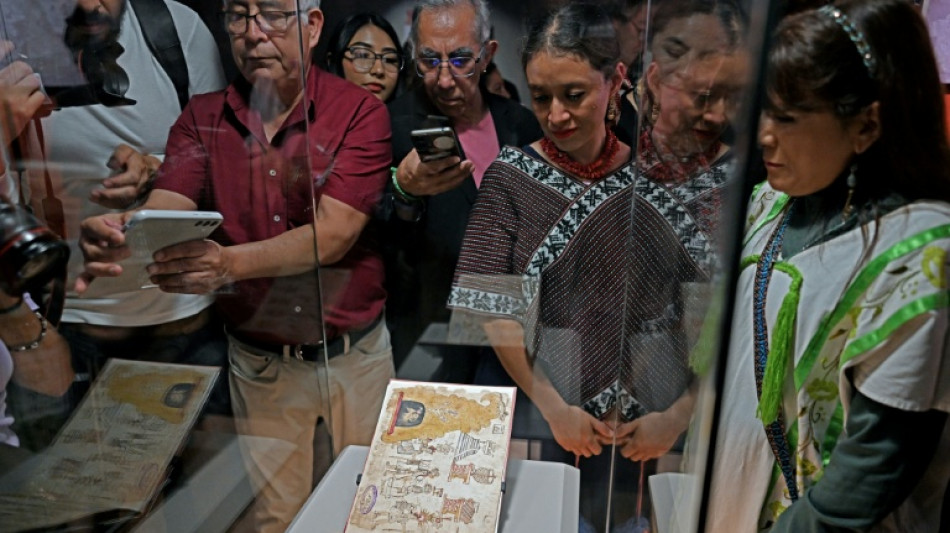
Prized Mexican relic returns on loan, two centuries on / Photo: © AFP

A cherished 16th-century Mexican manuscript that tells the history of the Aztecs in pictograms went on display Thursday in Mexico City, nearly two centuries after it was whisked off to France.
The Codex Azcatitlan recounts the history of the Aztec civilization, from the creation of the Aztec Empire to its fall during the Spanish conquest, which ushered in Christianity.
Mexico has been demanding for years that France return it but so far France has refused.
Members of an Indigenous group that has campaigned for its restitution reacted ecstatically to seeing two folios from the precious document on display inside a glass case at the National Museum of Anthropology.
"They hid our history from us, they stole it!" Emilia Mendoza of the Hnahnu community told AFP at the opening of the exhibition.
"This is a battle won, a first step toward the restitution of these books that reside in other countries," she said.
Speaking at the inauguration, Foreign Minister Roberto Velasco said the exhibition was about "reuniting a population with its (collective) memory."
The pictograms "represent our history, the written voice of our ancestors, and the deep root of our identity," he said.
- 'Why isn't it in Mexico?' -
Written shortly after the arrival of the Spanish in the 16th century, the codex, or manuscript, is considered one of the most important accounts of Aztec culture.
It narrates the migration from Aztlan, the mythical birthplace of Aztec civilization, to the promised land of Tenochtitlan, the forerunner of Mexico City.
Scenes rendered in vibrant reds, blues, greens and yellows depict warriors in feathered headdresses and ritual acts in pyramid temples.
France's National Library, which has maintained possession of it for over a century, loaned it to Mexico to commemorate 200 years of relations between the two countries.
But Mexico, which has launched a push to recover colonial-era cultural objects held outside the country, wants France to go further and hand it back.
Since 2018, over 16,200 items have been repatriated from various countries, the National Institute of Anthropology and History said last year.
Mexican President Claudia Sheinbaum pressed France's Emmanuel Macron to return the Codex Azcatitlan and another precious manuscript, the Codex Borbonicus, during a visit by the French president to Mexico last year.
"If it's from Mexico, why isn't it in Mexico?" Karen Trejo, a 28-year-old ethnohistorian, wondered at the exhibition opening.
- History of tensions -
The manuscript, which fills 25 sheets of parchment that were imported from Europe in the 16th century, was donated to the National Library of France in 1898 by the widow of the Franco-Mexican collector Eugene Goupil.
It was brought to France half a century earlier by Joseph Marius Alexis Aubin, a French researcher specializing in Indigenous American cultures.
It is one of two major volumes illustrating Indigenous Aztec life that have been kept in France, along with the Codex Borbonicus, which represents divinatory and solar calendars.
The Codex Borbonicus is kept at the library of French parliament's lower house, the National Assembly.
In 1982, the issue of colonial-era relics led to tensions between Mexico and France when a Mexican lawyer, Jose Luis Castaneda, stole another manuscript, the Codex Tonalamatl, from France's National Library and brought it back to Mexico.
France expressed anger over what it described as theft but Mexico rejoiced and held onto it.
Both the National Assembly and National Library insist they are the rightful owners of the other codices.
M.al-Mannai--BT